Q&A with Jojo
A few weeks ago, I asked my members to send me a bunch of questions that they would like me to answer. Some of them have responded, and with some really good questions, too! I've really enjoyed digging into them, and I hope you all enjoy reading my answers just as much. Huge thanks to this week's contributers!
Projects
What [writing projects] are you most excited about working on at the moment? ―Kieran
I'm absolutely, 100% the most excited about The Missing Mortimer, a detective novella that I'm very nearly finished editing. The plan is to follow it up with a series of short stories and other novellas about the same characters solving new mysteries (in the vein of Sherlock Holmes). It's a project that's been in the works in some form or another for about 6 1/2 years now, and it's thrilling to finally be so close to releasing the beginning of it!
In The Missing Mortimer, the recently-widowed Isabel Mortimer becomes worried when her late husband's heir mysteriously disappears. She enlists her hedonistic brother, Jimmy Howard, to help her circumnavigate the police and track down the young man, hopefully before something truly dreadful happens to him. The year is 1924, and mischief is afoot.
There will be more updates about this story and where you'll be able to read it in coming months, so stay tuned!
What are your favorite pieces of writing that you've done so far? ―Nic
Oooh, that's a tough one. I really enjoyed the play I wrote for my Master's degree, a Restoration-era-style comedy called Love's True Servant full of queer fun and so, so many innuendos. My supervisor and the actors friends I workshopped the script with all had a great time reading it and discussing it with me, and I found the process really encouraging. (Your Love's Refrain and A romantic extract are both from Love's True Servant.)
Some other short pieces that I particularly like include:
- "Monologue of a Whale", in which I rewrote one of my favourite passages of The Hitchhiker's Guide to the Galaxy in blank verse.
- "Toil and Trouble", a short story about a witch who runs a New York speakeasy and is always a sucker for a damsel in distress.
- "Hare Scent", which started as a short impression I jotted down on holiday and has grown to have something resembling a plot. I may expand on it again in future; what do you reckon?
- "But if My Brain...", a sonnet I smashed out in 20 minutes after a shower for a Twitter contest (back when it was Twitter and not entirely the worst).
Writing process
What's your favourite thing about writing? ―Nina
The simple answer is: it's play. Like many creative writers (and creatives in other media), I love the way writing latches onto my imagination and gives me scope to have fun with it. Growing up, I was constantly drawn to storytelling forms of play, such as dolls, dressing up, and make-believe. Small wonder, then, that I liked telling stories on paper too.
Make-believe is definitely a big part of how I got into creative writing, but I think as a nominal grown-up I've developed more of a Lego-style approach to writing as play. Yes, I get to move the minifigs around and take them on adventures, but it's even more fun because I get to put together the setting around them. How am I going to build a car for my little guy? What pieces do I use for the secret hideout? Do I have enough of these green pieces for all of the walls? I don't even need a story or characters to have fun this way; it's still playing with words and techniques when I write blog posts or essays or what have you. And boy do I relish it!
How do you decide what genre to use if you are writing fiction? Do you write in a form that you generally enjoy reading, such as murder mysteries? Or would another format suit you better and how do you decide? Eg. romance, fantasy, science fiction, adventure, how do you decide which format tells your story best? ―Alice
This is a really interesting question, and I've had to think about it a bit. Firstly, I usually come at this decision the other way around: rather than starting with a story idea and figuring out how to tell it, I usually start with the genre and form and figure out a good story that fits those parameters. For example, if I want to write a piece for a competition there will usually be a preferred genre and a word count given. In other cases, I decide that I want to write something in a specific genre or form because there's a technique or convention I want to experiment with. This is how I ended up writing (among other things) a stage farce, the detective story I mentioned above, and a lot of my sonnets.
Occasionally, I do start with a plot or character idea, and in those cases I explore the idea and consider if there are settings, conventions, or techniques that match up with it. In the case of Love's True Servant, for instance, I knew I'd be writing a comic play but didn't settle on the specific genre until I decided on the time period I would set the story in and narrative conventions I wanted to use. The late 17th century had the right feel, and the theatre movement of the time suited the conventions I was most interested in, so Restoration comedy it was.
In terms of whether I write in genres and forms I read a lot, it's a bit of a mixed bag. I love reading huge novels and sweeping fantasies (see Priory of the Orange Tree), but I could never write something that expansive. I could probably do to read more short fiction than I currently do, but I don't really write in genres I don't enjoy reading, because I wouldn't enjoy writing in them either.
I know you spent a lot of time working as a technical writer. How has that affected your creative writing ability? And is it hard to do both at the same time? ―Liz
For those who are new to the blog, I spent 9 years working professionally as a technical writer, which I loved doing. It's a job that focuses heavily on things like grammar and clarity, as we were tasked with writing instructions for people working in complex fields. I learned a lot about written communication in general and how to simplify complicated material so that other people can easily engage with it, which has made me a lot better at writing emails!
I think most of the ways technical writing has benefited my creative writing skills are in that general sense of improving my ability to communicate clearly, such as:
- knowing when to stop a sentence and split content into a new one.
- identifying which information is necessary and which is redundant.
- avoiding tautology.
- including all the points and not skipping over something that's less obvious than I think it is.
- putting things in the right order.
- being able to rearrange, reword, and trim sentences without changing their meaning.
We love transferable skills, and even though I'm not a technical writer anymore I still get a lot of mileage out of the way I learned to assess my writing.
I actually found that it wasn't difficult to switch from "tech writer brain" to "creative writer brain", because although I was staring at words on a screen for both activities I was using different types of creativity. In my day job, I was focused more on problem solving and efficiency, whereas my personal projects were more about imagination and flavour. A lot of my former colleagues are also creative writers, so I'm sure I wasn't the only one who felt like this.
What does the "seed" of your stories look like? How do they take shape when they first arrive in your head (e.g. for me, it's as a high concept)? ―Nina
As I alluded to a couple of questions up, a lot of my stories start off as a desire to play with a particular genre, convention or technique. I love novelty and challenging myself (coughADHDcough), so this tends to be a surefire way to hold my attention. Some examples of technical seeds are:
- What if I wrote a scene entirely in onomatopoeia?
- Writing a sonnet myself doesn't sound hard (oops now I'm obsessed with them).
- I want to try writing dialects!
- A farce sounds like a fun challenge... (now I want to do it again)
- Since I love blank verse so much, I should write a play in it!
Other stories come to me as a focused impression: an emotion or observation, a tantalising line of prose, or the flash of a character. I start with that detail and build outward, following the thought or fleshing out the image until I know what to do with it.
Writing techniques
Why, or when, would you use the present tense in writing? I find it an uncomfortable form when I read it and usually give up on books written this way. ―Alice
Present tense is not often used in the books I read, either. I'm not sure if there are specific genres that use it more, though I wouldn't be surprised if poetry and short fiction do. I reckon that past tense feels a lot more natural for most storytelling, which is probably why present tense jars with you so much.
As it happens, one of the short stories I'm tinkering on now is written in present tense, and I'm finding it a really interesting change. The biggest reason to use present tense is to create a stronger sense of immediacy, with the action happening right in the moment of its telling. It pairs well with first-person narration, and this combo is good at putting the reader in the character's head; it feels more like you're following them in real time.
I can see present tense being useful if you want to create a disconnect from time in your story, such as de-emphasising a sense of history or muddying the sequence of events. It could also help with tension in an action-filled story if you want to sweep the reader up in the momentum of increasing stakes and chaos. There are a lot of other reasons it might attract a writer, depending on the particular story. Those stories just might not be for you, and that's alright.
What makes a good critique? How do you give it? How do you interpret someone giving lots of suggestions into actionable critique? ―Nina
I've got a whole post about how to give a good critique, and I recommend giving it a read if someone's asked you for feedback on something! The short version is that a good critique is one that a) understands what the work is trying to do, b) identifies where the work does and does not succeed in its aims, and c) does not try to mold the work to the critique-giver's preferences. I would also say that for a critique to be well received, it should be asked for (seriously, don't give unsolicited feedback; it won't be appreciated) and kind. I don't mean that there can't be criticisms―those are kind of important―but that there's no call to be harsh. Pointing out the good bits and framing the bits that aren't working as opportunities for improvement will make your critique a lot more encouraging for the person on the other end of it.
Of course, just because you know how to give a good critique doesn't mean that the people giving you feedback will, and it's inevitable that at some point someone will take things too far and try to rewrite things for you. If you have asked for critique and gotten a list of suggested changes instead, here's how I'd advise dealing with them:
- Don't take any suggestions at face value. Always think the changes through before applying anything.
- Identify what problems the suggestions are trying to address. Hopefully your critiquer has mentioned this, but if not you'll need to try and figure it out.
- Once you know the problem, determine whether it is actually a problem. It might be a matter of preference (unhelpful), or a symptom of something else that isn't working or that hasn't been made clear enough.
- For each real problem, consider different ways you could fix it. Your critiquer has provided one option, but there might be a more appropriate or effective solution.
- Implement the changes that you think will be best for your work!
- Maybe find someone else to run the next draft by.
Life
I'm also interested to know how you think about being a writer as you move through the rest of the world; does it make you more observant? Less able to fully immerse yourself in a moment, because you're thinking about it as though it was being written? More able to immerse yourself, because you're in touch with your inner thought life at other times so can switch it off? Any other insights about how writing impacts the rest of your lived experience? ―Kieran
Ooooh, what a fascinating series of questions! This is another one I've had to really think about. I have no idea if being a writer makes me more observant when I'm not deliberately trying to notice things (signs point to unlikely), but I think it does make me more inclined to want to take notice, if that makes sense, and I can get more out of the experience of observing.
Regarding your subsequent questions, I think that the act of describing a moment as though I'm writing it actually helps me immerse myself. My internal monologue is constantly pinballing all over the place, often in several directions at once, so in order to really appreciate a moment I have to make an effort to hold my focus on it, and I've found that a good way to do that is to observe the moment carefully and savour it in words. In general (and you may remember this from our uni days), I find that analysing the crap out of things doesn't ever ruin my ability to enjoy them, but rather gives me more appreciation for them. However, I think that's unrelated to writing and just a quirk of being me!
It's hard to say how writing, specifically, affects the way I move through life. I suppose it fosters curiosity, leading me to wonder why and how things come about. Seeing the world through a narrative bent highlights how connected people and events are, and the ways they affect each other. And I think I'm more appreciative of people's individuality when I think about what makes characters interesting!
You've been talking about your cats... can I meet them please??? ―Nic
You sure can!
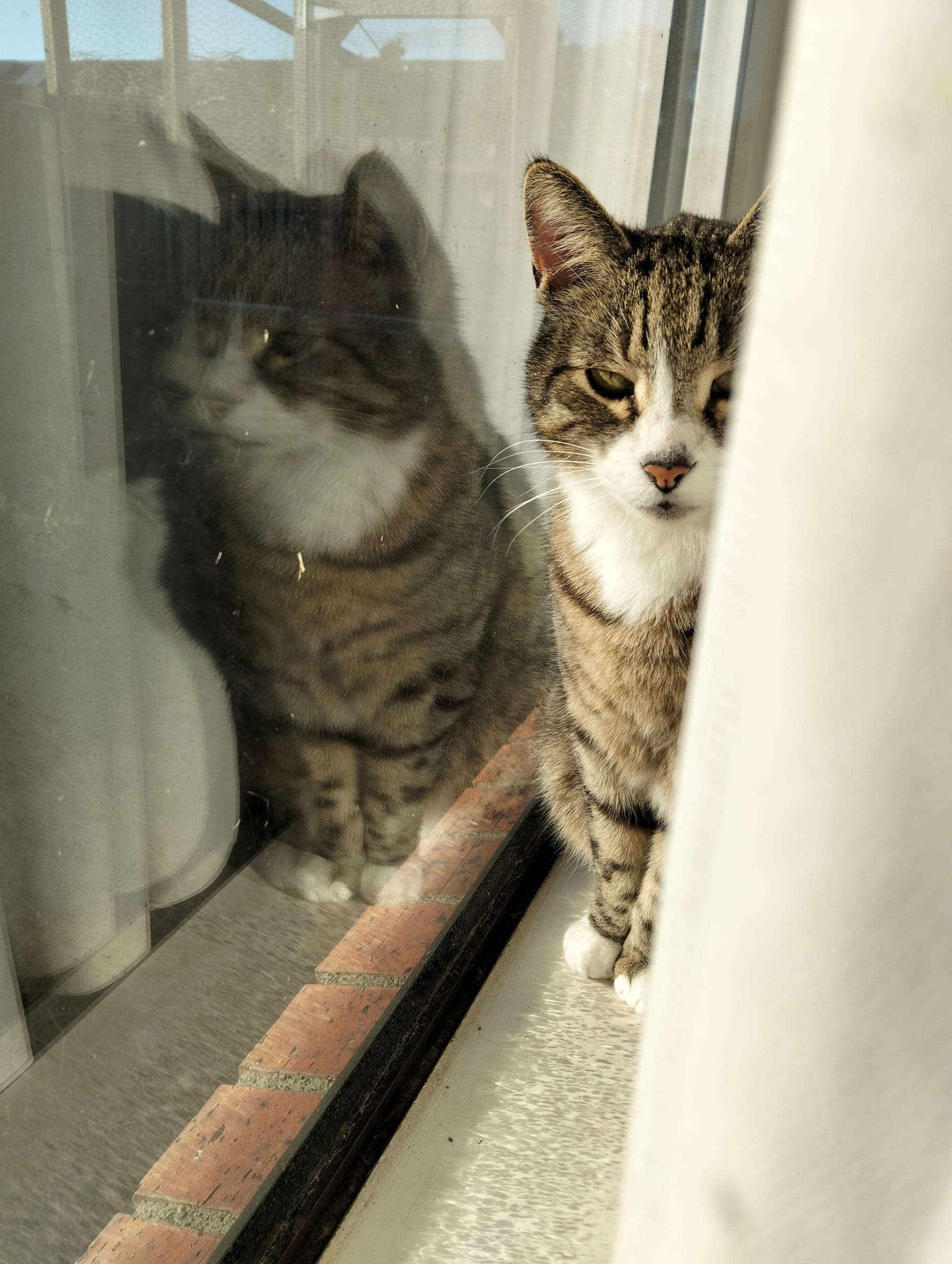
This is Jarvis, our self-appointed Head of Household Security. He likes snuggling on the bed, eating fresh catnip, and patrolling the back garden in his harness. He dislikes visitors and nonsense (especially little sister nonsense). Sometimes he's too clever for his boots and sneaks outside when I'm not looking just to show off, and has on several occasions been stuck waiting for me in the garden for hours while I was out because I missed his escape.
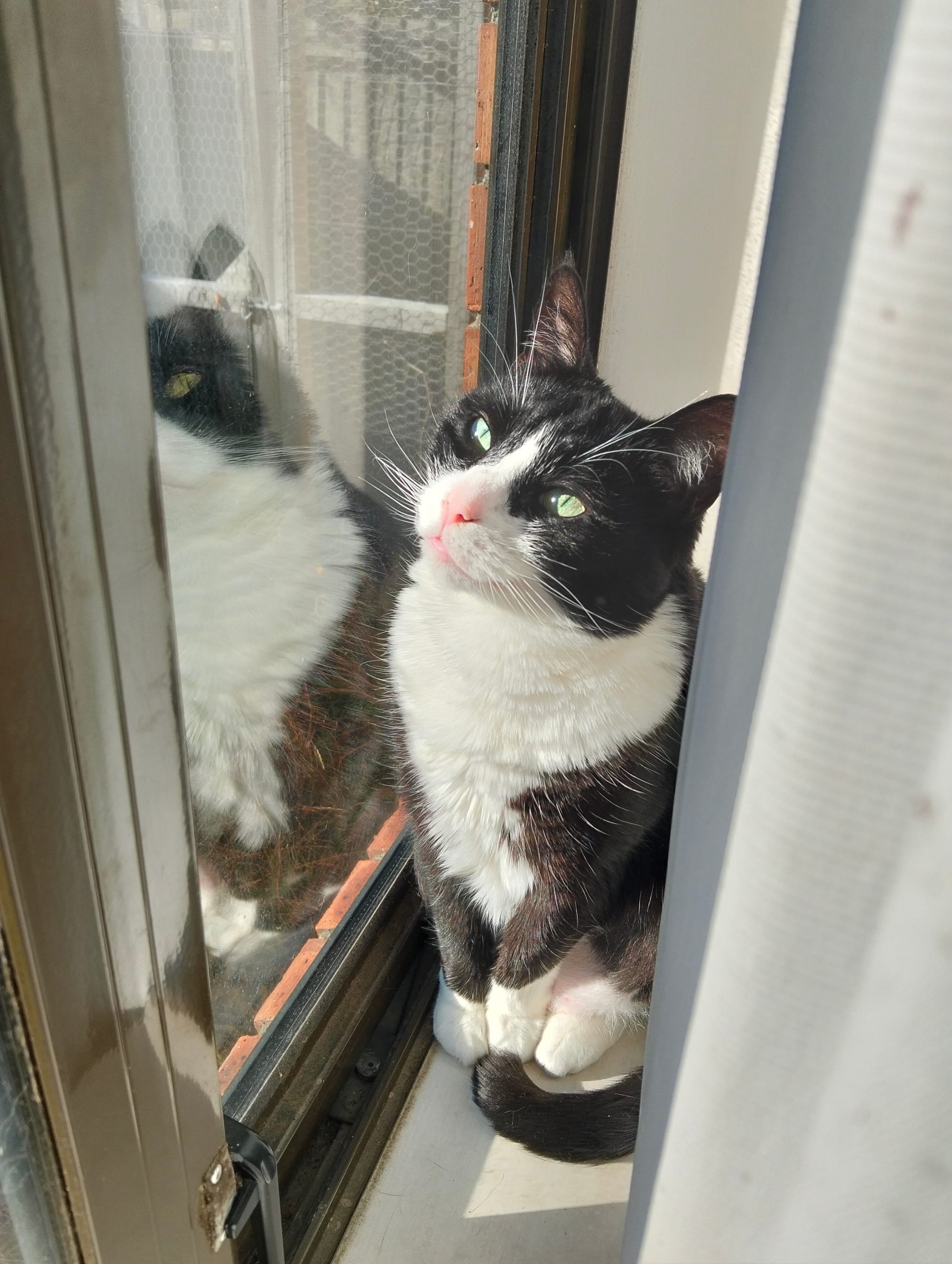
And this is Sophie, who is essentially a clueless laborador in a cat's body. She likes bothering Jarvis, eating popcorn and potato chips off the floor, and yelling SO LOUD. She dislikes being picked up and going to the vet because she ate something that's categorically not food. At least once a day she makes me follow her around the house and play her like a bongo, ideally while she sticks her head under a piece of furniture.
Phew, that's a lot of words! Thank you again to everyone who sent in questions. We should do it again sometime!
Member discussion